
Floral trends evolve every year, but some shifts go far beyond aesthetics.
What is emerging in 2026 tells a deeper story than a simple change of style. It reflects a profound transformation in the way weddings are imagined and experienced.
More and more couples feel the need to slow down.
To do less, but better.
To move away from spectacular settings — impressive in the moment, yet quickly forgotten — and toward atmospheres that feel more sincere, more grounded, more alive.
In this context, floral decoration is no longer just one decorative element among others. It becomes a guiding thread. A silent language capable of connecting places, moments and emotions, without ever overpowering them.
One of the most striking evolutions concerns our relationship with the flowers themselves.
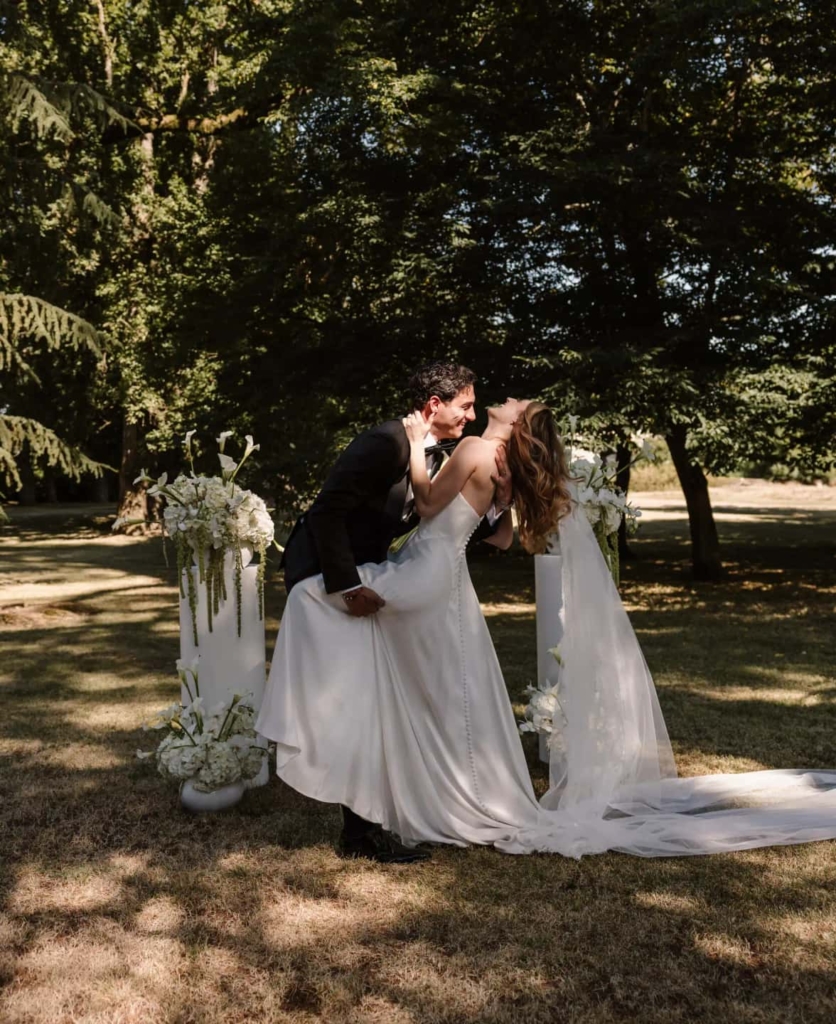
Highly structured, perfectly symmetrical arrangements are gradually giving way to freer, more organic designs. Lines soften, volumes breathe, and the décor sometimes feels as though it has settled there almost spontaneously.
And that is a good thing — because at Buzzy Bee, we love working with nature, the way nature works.
This search for naturalness is certainly not a lack of craftsmanship.
On the contrary.
It relies on a deep understanding of plants and an ability to compose with living, evolving, sometimes unpredictable materials. Textured foliage, garden flowers and stems with irregular curves bring a visual and emotional depth that overly polished arrangements simply cannot offer.
Some flowers may even change throughout the day — opening, bending, shifting with the light. That living quality is part of their beauty.
For many brides, this approach creates a sense of ease.
The décor does not seek to impress, but to envelop — to enhance, rather than to dominate.
The 2026 trends also reflect a sense of calm in colour choices.
Palettes are built around natural, enveloping tones: ivory, cream, warm beiges, muted greens, mineral shades. These colours create a reassuring base, capable of working with very different venues without ever overwhelming them.
Colour has not disappeared.
It simply expresses itself differently.
In touches. With restraint.
A deeper tone, a slightly contrasting nuance punctuates the décor at precise moments, adding rhythm without saturating the space.
The focus is no longer on immediate impact, but on overall coherence. Colours are conceived at the scale of the entire wedding day, accompanying the celebration from beginning to end, in dialogue with light, materials and transitions between spaces.
This search for chromatic balance is also reflected in the growing interest in Pantone’s Colour of the Year — not as a shade to apply literally, but as a creative starting point. Translated into flowers, softened by neighbouring tones or balanced with complementary hues, these references become a subtle tool to enrich a palette without locking it into a fleeting trend.
Another major evolution is becoming clear: flowers are no longer designed in isolation.
They are part of a global scenography, conceived as an emotional journey.
A wedding is experienced in motion. We arrive, we discover, we move through spaces, we gather. Floral scenography accompanies these movements, marks key moments and creates pauses. It guides without directing, suggests without imposing.
This holistic vision allows for true coherence, even when the spaces themselves are very different. Ceremony, cocktail hour and reception speak to one another, carried by a shared aesthetic intention.
These evolutions have very concrete implications when designing a floral project.
They invite us to think less in terms of “how much” and more in terms of feeling.
Where should the eye be drawn?
Where should emotion intensify?
And where, on the contrary, should space be allowed to breathe?
For many couples, this approach also brings a sense of serenity.
The décor no longer needs to be perfect from every angle. It needs to be right — coherent, meaningful, aligned with their story and with the chosen venue.
Another underlying trend is our relationship with time and with living things.
Working with seasonal flowers has become an obvious choice for many couples — not out of constraint, but out of a desire for coherence. Seasonal flowers integrate more naturally into their environment, offer better longevity and a truer palette.
They also allow the wedding to be anchored in a specific moment in time:
“It happened in autumn, in the city where I grew up…”
This approach reshapes our understanding of luxury.
Luxury is no longer found in excess or in imported rarity, but in the relevance of each choice. Using what is available at the right moment, in the right context, becomes a marker of quiet elegance.
These new approaches also help avoid some common pitfalls:
The 2026 trends invite, instead, more measured and thoughtful choices — choices that stand the test of time.
Wedding floral trends for 2026 express a deep desire to return to what truly matters.
Décors that are less demonstrative, yet more inhabited.
Flowers chosen for what they express, not for what they impress.
When interpreted with sensitivity, these trends cease to be passing fashions. They become a language — a discreet language, capable of supporting emotion without ever diverting it.
These are the kinds of settings I hope you will remember — and feel — long after the wedding day has passed.
If you would like to see how these ideas translate venue by venue, our floral inspiration for every kind of setting gathers them, and our wedding florist in the South of France page explains how we shape them into one coherent project. Get in touch whenever you would like to talk yours through.
Back to news
other news

26/07/2026

17/07/2026
17/07/2026

17/07/2026
Stay updated


